


White last names carry centuries of history, culture, and identity rooted deep in European heritage. From old English settlements to German villages, from Irish coastlines to French noble courts, these surnames traveled across oceans and generations, shaping families and nations along the way.
Whether you are researching your family tree, searching for the perfect name for a fictional character, or simply curious about ancestral background, this complete guide covers everything you need to know about white last names, their origins, powerful meanings, and how to choose one that truly resonates.
Most Common White Last Names In America
According to U.S. Census Bureau data, the most common white last names in America reflect deep waves of English, Irish, Scottish, and German immigration across centuries. These popular white surnames in America are not just names they are living records of migration, occupation, and family lineage.
| Rank | Last Name | Meaning / Origin |
| 1 | Smith | Metal craftsman (Old English) |
| 2 | Johnson | Son of John (Patronymic) |
| 3 | Williams | Son of William (Welsh/English) |
| 4 | Brown | Dark complexion or hair (Descriptive) |
| 5 | Jones | Son of John (Welsh/English) |
| 6 | Miller | Grain mill worker (Occupational) |
| 7 | Davis | Son of David (Welsh) |
| 8 | Anderson | Son of Andrew (Scottish) |
| 9 | Taylor | Cloth cutter (Occupational) |
| 10 | Thomas | Twin born child (Biblical) |
| 11 | Wilson | Son of Will (Patronymic) |
| 12 | Moore | Marsh or fen dweller (Locational) |
| 13 | Harris | Son of Harry (Patronymic) |
| 14 | Martin | Warrior of Mars (Latin) |
| 15 | Thompson | Son of Thomas (Patronymic) |
These most common white last names in America largely trace back to England, Scotland, Ireland, and Germany, reflecting the major waves of European migration between the 17th and early 20th centuries. Occupational names like Smith and Miller, patronymic names like Johnson and Anderson, and locational names like Moore and Hill are all strongly represented in white American surname data.
Unique White Last Names With Meanings
If you want a surname that stands apart while still carrying strong European heritage, here are some of the most unique white last names with meanings worth exploring.
- Whitman: Refers to a fair-haired or light-complexioned person from Old English roots
- Fairchild: Meaning a beautiful or beloved child, often associated with gentle aristocratic families
- Sinclair: Derived from the French “Saint Clair,” meaning clear and bright; a name with Norman roots
- Pembroke: A Welsh locational surname meaning headland near water, historically tied to noble earldoms
- Winslow: Old English for “friend’s hill,” popularized through art and American colonial history
- Blackwell: Refers to a dark spring or stream, a place-based English surname
- Fairfax: Norman French in origin, meaning beautiful and flowing hair; tied to English aristocracy
- Kingsley: Means “king’s meadow,” reflecting a connection to royal land holdings
- Sterling: Suggests high quality and excellence; also tied to Scottish place names
- Ashford: Old English for a ford near ash trees, a charming locational surname
- Westwood: Means western forest, a nature-rooted surname popular in rural English communities
- Whitmore: Old English for white open moorland, evoking the landscapes of northern England
These unique white last names with meanings work equally well for family use, baby naming, or creative character development in stories and games.
Rare White Last Names For Baby Boys
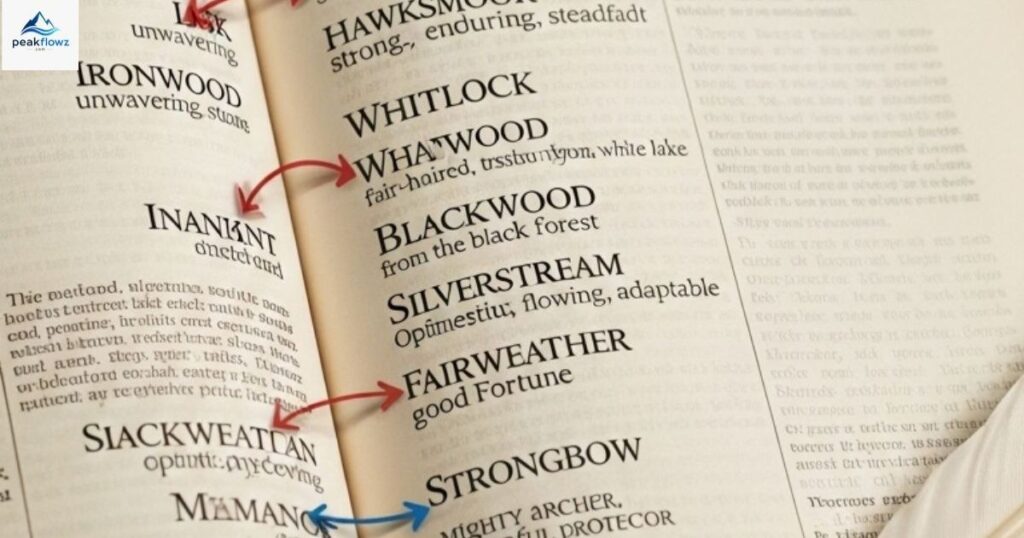
Finding a rare surname for a baby boy can feel like uncovering a forgotten treasure. These rare white last names for baby boys combine classic European heritage with a distinctive sound that sets them apart.
- Ashworth: Ash tree enclosure; strong, grounded, and deeply English
- Caldwell: Cold water spring; evokes natural landscapes of the British countryside
- Dunmore: Great hill fortress; a proud Scottish surname with noble weight
- Farnsworth: Fern-covered area; a rare Old English surname that sounds both literary and refined
- Greenwood: Lush forest area; tied to medieval English forest life and Robin Hood lore
- Hartley: Deer meadow land; a tender yet strong name from northern England
- Lockhart: Fortress with gate; suggests protection and strength with Scottish roots
- Mortimer: From the Anglo-Norman, meaning “dead sea”; historically tied to powerful English baronial families
- Northwood: Northern forest region; rare, nature-inspired, and unmistakably English
- Pemberton: Barley farm settlement; old-fashioned charm with Welsh border origins
- Radcliffe: Red-colored cliff; a place-based surname linked to Lancashire, England
- Elsworth: Noble estate land; a sophisticated and uncommon choice for a son
Elegant White Last Names For Girls
For baby girls, elegant white last names bring timeless sophistication and a sense of graceful heritage.
- Windsor: Royal riverbank estate; the name of the British royal family itself
- Lancaster: Roman fort site; carries the weight of English royalty and the Wars of the Roses
- Beaumont: French for “beautiful mountain”; an elegant Norman surname with a romantic feel
- Harrington: Distinguished English surname meaning “herring town”; often associated with nobility
- Wellington: Wealthy estate land; immortalized by the Duke of Wellington and a symbol of British pride
- Livingston: Scottish in origin, meaning “dear friend’s settlement”; refined and softly poetic
- Worthington: Enclosed farm settlement; sounds distinguished and carries quiet class
- Kensington: Town of Cynesige; an aristocratic English place-name associated with London royalty
- Arlington: Eagle’s town place; widely used in both American and British noble contexts
- Huntington: Hunter’s settlement area; a classic aristocratic surname used in both fiction and history
- Remington: Raven farm settlement; sounds powerful yet graceful for a modern girl’s surname
- Covington: Cove farm place; a classy white surname for stories and elegant character naming
Traditional White Surnames From England
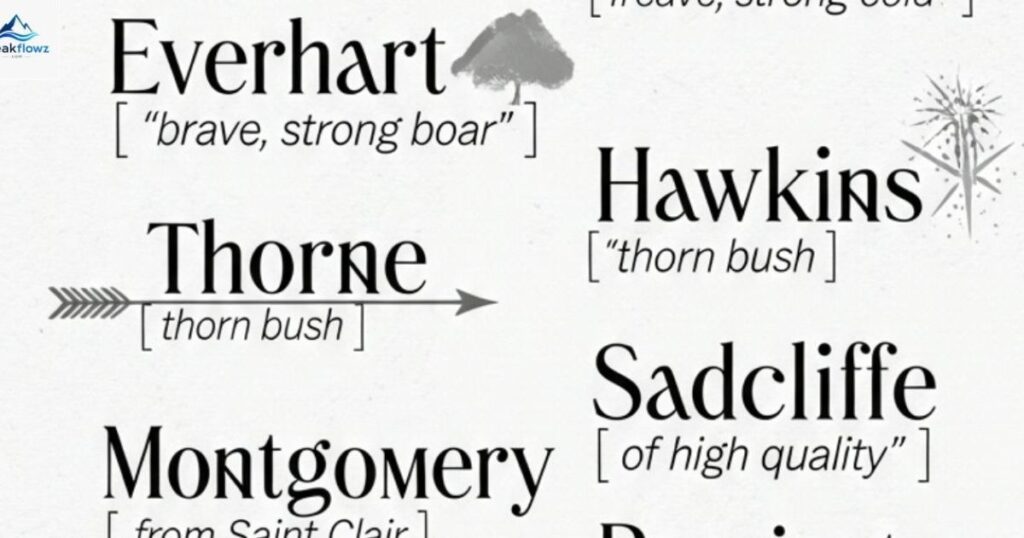
England has produced some of the most enduring and recognized surnames in the world. These traditional white surnames from England reflect the landscapes, occupations, and parish life of medieval Britain.
- Churchill: Church on a hill; one of Britain’s most iconic surnames, tied to prime ministerial legacy
- Bradford: Broad river crossing; reflects Yorkshire geography and industrial heritage
- Sheffield: Sheep grazing field near the River Sheaf; a proud northern English surname
- Wakefield: Feast day field; a Yorkshire place-name with medieval church festival origins
- Langley: Long meadow land; a gentle rural surname found across English counties
- Clifford: Cliff near a ford; a strong English locational name tied to a powerful baronial family
- Stratford: Street near a ford; famous worldwide through association with Shakespeare’s birthplace
- Stafford: Landing place ford; tied to the Staffordshire region and its noble history
- Hartford: Deer river crossing; combines nature imagery with classic English place-name tradition
- Whitfield: White open field; a simple, honest English surname rooted in agricultural life
- Humphrey: Peaceful warrior spirit; a given name turned surname with Norman French origins
- Radford: Red river crossing; a place-based surname found across the English Midlands
Popular White Family Names In The US
The story of popular white family names in the US is inseparable from the story of European immigration. From Puritan settlers to Ellis Island arrivals, each surname carried a piece of the Old World into the New.
- Wilson: Son of Will; consistently one of the most recognized surnames in American history
- Walker: A cloth-walker by profession; workers who cleaned wool by walking on it
- Clark: Clerk or scholar; originally referred to someone who could read and write
- Lewis: Famous warrior; a Welsh and English surname that crossed to America early
- Hall: Manor hall worker; associated with great houses and noble estates
- Robinson: Son of Robin; a warm, friendly English surname common across all American states
- White: Fair complexion or light hair; the surname “White” itself has deep British roots dating to 1070 AD
- Baker: Bread maker; a straightforward occupational name common across English-speaking communities
- Allen: Harmony or little rock; of Irish and Breton origin, widely popular in America
- Scott: A Scot or person from Scotland; a simple, strong surname reflecting migration patterns
- Green: Someone who lived near a village green; a cheerful, nature-based English surname
- Young: Youthful person; a descriptive nickname that became a lasting family name
Old Fashioned White Last Names
Old-fashioned white last names carry a vintage charm that many parents and writers find irresistible. These are surnames that feel like they belong in a Jane Austen novel or a Victorian family portrait.
- Weatherby: Wether sheep farm; wonderfully archaic and English countryside in feel
- Pendleton: Hill with enclosure; a melodic old-fashioned surname with strong character
- Middleton: Middle farm settlement; familiar from British royalty but historically much older
- Worthington: Enclosed worthy farm; a name that sounds like it belongs to a gentleman of means
- Bannister: Basket maker craftsman; charmingly outdated and tied to medieval guild culture
- Kimball: Warrior chief leader; a bold, old-fashioned name with Anglo-Saxon warrior roots
- Wentworth: Winter enclosed area; evokes cold-weather English estates and 19th-century novels
- Brewster: Female beer maker; one of the more endearing occupational surnames from medieval England
- Thatcher: Roof thatcher worker; simple, working-class heritage with honest occupational roots
- Fletcher: Arrow maker craftsman; medieval and evocative, perfect for historical fiction
- Chandler: Candle maker and seller; a charming trade surname associated with pre-industrial England
- Carver: Wood sculptor or craftsman; an artisanal surname with gentle artistic associations
Strong White Last Names For Characters

Writers and game designers know that a character’s surname shapes how readers perceive them. Strong white last names for characters create instant personality, backstory, and gravitas.
| Name | Meaning | Best For |
| Steele | Hard like metal | Anti-hero or warrior |
| Stone | Strong like rock | Stoic protector |
| Hunter | Game hunting person | Action hero or ranger |
| Knight | Mounted warrior soldier | Noble or chivalric hero |
| Wolfe | Wolf-like and fierce | Dangerous antagonist |
| Frost | Cold and powerful | Ice-themed villain or hero |
| Storm | Powerful weather force | Elemental warrior |
| Archer | Bow and arrow user | Skilled marksman character |
| Hawk | Sharp-eyed hunter | Scout or spy character |
| Justice | Fair and righteous | Lawman or judge figure |
| Power | Strength and authority | Commander or leader |
| Savage | Wild and fierce | Ruthless warrior figure |
These strong white last names for characters work because they carry built-in meaning. A character named Wolfe arrives with implied danger. A character named Justice arrives with implied moral weight. That is the power of an intentional surname.
Classy White Surnames For Stories
If you need names that feel educated, wealthy, and socially polished, these classy white surnames for stories deliver exactly that atmosphere.
- Worthington: Distinguished noble estate; perfect for aristocrats, lawyers, or old-money families
- Pemberton: Elegant barley farm; a refined name used in Victorian literature and modern dramas
- Thornton: Thorn settlement; classic and classy, used by Charlotte Brontë and countless authors since
- Montgomery: Mountain belonging to a hunter; a Scottish and French aristocratic name of real historical weight
- Harrington: Distinguished herring town; sounds far more elegant than its fishy origin suggests
- Carrington: Marsh settlement town; made famous by the television series Dynasty, still feels timelessly rich
- Lexington: Law town settlement; an American place-name repurposed beautifully as a surname in fiction
- Addington: Noble estate town; subtle, refined, and easy to pair with almost any first name
- Barrington: Barley farm place; sounds wealthy and old-world, ideal for manor house settings
- Whitmore: Refined white moor; elegant and understated, a surname that whispers old money
Short And Simple White Last Names
Not every surname needs weight and history behind it. Short and simple white last names are clean, easy to pronounce, and surprisingly versatile.
- King: Royal ruler; one syllable, maximum authority
- West: Western direction dweller; directional surnames feel modern and cool
- Young: Youthful age person; bright, optimistic, and timeless
- Hill: Elevated land dweller; humble, grounded, and universally familiar
- Bell: Bell ringer or bell maker; melodic, memorable, and softly beautiful
- Wood: Forest dweller; one of the oldest nature-based English surnames
- Page: Young servant or helper; literary and light
- Ford: River crossing place; strong, one-syllable, and tied to American presidential history
- Kent: Coastal region dweller; clean and crisp with ancient British roots
- Dale: Valley dweller person; gentle, rural, and underused in modern naming
- Cole: Dark complexioned person or charcoal worker; quietly stylish and modern
- Reed: Red-haired person or reed cutter; soft, natural, and easy to love
- Fox: Cunning and clever; one of the most characterful short surnames in English
Rich Sounding White Last Names
Some surnames carry an unmistakable air of wealth and status. These rich-sounding white last names have associations with old money, prestigious addresses, and powerful families.
- Vanderbilt: From the estate or hill; associated with one of America’s most famous wealthy dynasties
- Rockefeller: Rock field dweller; synonymous with American industrial wealth and philanthropy
- Carnegie: Rocky hill place; the Scottish-American steel magnate made this surname globally recognized
- Astor: Hawk-like person; a French-origin surname tied to one of America’s earliest elite families
- Forbes: Field or meadow; a Scottish clan name that became a byword for financial success
- Windsor: Royal riverbank estate; the name of the British Royal Family, need nothing more be said
- Wellington: Wealthy estate land; carries the prestige of one of Britain’s greatest military heroes
- Kensington: Royal town area; associated with London’s most expensive and exclusive postcodes
- Remington: Wealthy settlement place; sounds both rustic and refined simultaneously
- Covington: Prestigious cove farm; a smooth, upper-class sound with clean vowel flow
White Last Names That Sound Royal
Royalty has a distinct surname quality: sonorous, historical, and impossible to ignore. These white last names that sound royal tap into that sense of lineage and grandeur.
- Windsor: The ruling House of Windsor has carried this name since 1917
- Lancaster: One of England’s great royal houses, central to the Wars of the Roses
- York: The House of York rivaled Lancaster for the English throne for generations
- Tudor: The dynasty that produced Henry VIII and Elizabeth I; unforgettable in English history
- Stuart: Royal household steward origins; the Scottish royal house that united Britain
- Plantagenet: Ancient royal family named for a broom plant sprig; England’s longest-ruling dynasty
- Essex: East Saxon kingdom name; an earldom title associated with royal courts
- Cornwall: Royal duchy title granted to the eldest son of the British monarch
- Cambridge: Bridge over the Cam; a modern royal title carried by King William
- Buckingham: Buck meadow land; forever associated with the palace and the British throne
White European Surnames And Meanings
European surnames span dozens of languages and cultural traditions. These white European surnames and meanings reflect the breadth of the continent’s naming heritage.
| Country | Surname | Meaning |
| Germany | Mueller | Mill worker |
| Germany | Schmidt | Metal smith |
| Germany | Fischer | Fisherman |
| Germany | Weber | Cloth weaver |
| Germany | Hoffman | Courtier or farm steward |
| France | Dubois | From the woods |
| France | Lefevre | The smith |
| Italy | Rossi | Red-haired person |
| Poland | Kowalski | Blacksmith |
| Scandinavia | Larsen | Son of Lars |
| Scotland | MacDonald | Son of Donald |
| Ireland | Murphy | Sea warrior |
These white European surnames and meanings showcase how different cultures approached the same fundamental challenge: telling one John apart from another. Occupation, location, physical description, and parentage all played their role, producing a rich diversity of family names across the continent.
Rare British White Last Names
Some of Britain’s rarest surnames are also its most spectacular. These rare British white last names have survived centuries of change and still carry an extraordinary weight of history.
- Featherstonehaugh: Pronounced “Fanshaw”; a stone enclosure place-name, among England’s most famously unpronounceable surnames
- Cholmondeley: Pronounced “Chumley”; a Cheshire place-name carried by an ancient English baronial family
- Beauchamp: Norman French for “beautiful open field”; pronounced “Beecham” in English noble tradition
- Willoughby: Willow farm settlement; a medieval English locational surname associated with Lincolnshire gentry
- Fortescue: Meaning “strong shield”; a Norman surname of proud Devon origins
- Arundel: Horehound valley place; a West Sussex castle town that gave its name to one of England’s oldest earldoms
- Throckmorton: Swamp settlement place; a Worcestershire name linked to the Gunpowder Plot of 1605
- Talbot: Believed to derive from “valley-bright”; a Norman surname tied to the Earls of Shrewsbury
- Cavendish: Cafa’s enclosed pasture; the family name of the Dukes of Devonshire, one of England’s wealthiest families
- Plantagenet: Broom plant sprig; the family name of England’s medieval kings from Henry II to Richard III
White Last Names From German Ancestry
German immigrants brought with them a rich tradition of occupational and descriptive surnames. These white last names from German ancestry remain common across the American Midwest and Pennsylvania, reflecting the heavy German settlement of those regions.
- Zimmermann: Carpenter or wood worker; one of the most common German surnames brought to America
- Schumacher: Shoemaker or cobbler; a proud craft surname that traveled well across the Atlantic
- Lehmann: Feudal tenant farmer; reflects the agricultural social structure of medieval Germany
- Koch: Cook or kitchen worker; simple, occupational, and found throughout German-American communities
- Bauer: Farmer or peasant worker; the most basic and honest of German occupational names
- Schulz: Village mayor or headman; a title-turned-surname reflecting local civic authority
- Schroeder: Cloth cutter or tailor; a German craft name similar in origin to the English Taylor
- Neumann: New arrival person; given to newcomers in a community, still widely used today
- Schwarz: ark or black-haired person; a simple descriptive German surname
- Braun: Brown-haired person; straightforward and among the most recognized German family names
- Lange: Tall person; a height-based descriptive surname used throughout Germanic-speaking Europe
- Krause: Curly-haired person; a delightfully specific physical description turned family name
- Vogt: Bailiff or legal officer; a title-based surname indicating administrative authority in medieval German towns
Benefits of Choosing White Last Names
1. Strong Cultural and Family Roots
Choosing a white last name connected to your actual ancestry creates a living link to family history. Many European heritage surnames appear in genealogy records stretching back centuries, making them invaluable tools for tracing lineage. When a surname has clear occupational, locational, or patronymic roots, it tells a story about who your ancestors were and where they lived.
2. Timeless and Classic Appeal
Traditional white surnames have a classic quality that does not age. Whether you prefer old-fashioned white last names that feel Victorian and literary or clean, modern white family names that fit a contemporary lifestyle, these surnames stay relevant across generations. There is a reason names like White, Stone, and Moore have remained in continuous use for centuries.
3. Wide Variety of Unique Options
The range of available white last names is extraordinary. From rare British white last names that only a handful of families carry, to common Irish surnames recognized across the world, there is truly something for every taste and purpose. You can find short, punchy names or elaborate aristocratic surnames that feel like a full biography in themselves.
How to Choose the Perfect White Last Names
Start by connecting with your own family history and European heritage. Understanding whether your ancestors came from England, Ireland, Scotland, Germany, or France will help narrow down surnames that feel authentic rather than arbitrary.
Consider the sound and rhythm of the full name. Short and simple white last names like Fox, Reed, or Bell pair cleanly with almost any first name, while longer European surnames like Worthington or Pemberton create a more formal and distinguished sound. Think about how the name will appear in writing, how it will sound when spoken aloud, and whether it suits the personality or character you have in mind.
For genealogy purposes, look into actual family records, parish registers, and census data. Many free and paid genealogy platforms allow you to search surname origin, family name meaning, and historical distribution. This kind of ancestral background research turns a name from a label into a legacy.
If you are choosing a surname for fiction or character writing, think about what the name should communicate before you open a name list. A character named Frost will feel different from a character named Bloom. Classy white surnames for stories work because they carry pre-loaded cultural associations that readers pick up immediately.
Expert Tips for Finding Unique White Last Names
Dig into medieval records and old parish registers. Vintage white surnames from the 12th to 16th centuries often have deep, layered meanings tied to specific geographic locations in England, Wales, Scotland, Ireland, or Germany that simply cannot be found in modern name lists.
Look for surnames that combine two meaningful elements, such as Ashworth (ash tree enclosure), Blackwell (dark spring), or Greenwood (lush forest). These compound surnames feel both distinctive and rooted in natural landscape imagery that gives them timeless appeal.
Consider the occupational naming tradition. Many popular white surnames in America began as job titles: Smith, Thatcher, Chandler, Fletcher. These names carry honest, working-class dignity and are easy to research because the original trade is self-evident.
Pay attention to rare British white last names from specific English counties. Cornwall, Yorkshire, Devon, and Shropshire each produced distinct regional surnames that feel fresh today precisely because they stayed local for so long.
Related Name Ideas
If white ancestry names appeal to you, several connected categories are worth exploring. Classic European surnames from France and Italy carry similar elegance to English aristocratic names. Anglo-Saxon last names offer an even older layer of English naming history, reaching back before the Norman Conquest of 1066.
Scandinavian surnames like Larsen, Hansen, and Berg carry the same clean, nature-rooted quality as many English white last names. Scottish clan surnames such as Campbell, MacDonald, and Fraser feel powerful and ancient, while Irish patronymic names beginning with “O” or “Mac” carry a deeply musical quality.
Aesthetic white last names for usernames are also worth considering. Names like Frost, Sterling, Wren, and Ashford work beautifully in digital spaces, carrying personality without being attention-seeking.
Personal Experience
Researching white last names over years of genealogy work reveals how much a simple surname can unlock. Tracing a single family name back through census records, ship manifests, and parish registers creates a trail that connects modern individuals to specific villages in England, farms in Germany, or coastal towns in Ireland.
The most striking discovery is often not the famous names but the everyday ones. Surnames like Thatcher, Fletcher, and Baker once described real people doing real jobs in real communities. When you find that your own family name meant “farm steward” or “arrow maker,” something personal and powerful connects you to those ancestors in a way that no history book fully replicates.
Frequently Asked Questions
What are the most common white last names in America?
According to Census Bureau data, Smith, Johnson, Williams, Brown, and Jones are the top five, all reflecting English heritage and centuries of white American family history.
Are white last names only from England?
Not at all. They come from across Europe including Scotland, Ireland, France, Germany, Italy, Scandinavia, and Poland, each contributing distinct surnames shaped by local language and culture.
How can I find the meaning of a white surname?
Genealogy platforms, surname origin databases, and national census archives are reliable starting points for researching family name meaning and historical surname roots.
What makes a white last name unique?
Rare spelling, a specific locational origin, an uncommon occupational root, or simple low frequency of use can all make a surname stand out from more common white family names.
Can white last names be used for characters?
Absolutely. Strong white last names for characters are widely used in novels, films, television, and games because they carry immediate cultural associations that enrich a character without needing explanation.
Are there short white last names?
Yes, many exist. Names like Fox, Reed, Cole, Bell, King, and West are all short, sharp, and highly versatile across personal and creative uses.
Do white last names have noble origins?
Many do. Aristocratic white surnames like Windsor, Lancaster, Cavendish, and Plantagenet trace directly to British royal and noble families with documented lineages stretching back to the Norman Conquest.
What are old fashioned white last names?
They are vintage white surnames popular in medieval and Victorian times, including names like Weatherby, Wentworth, Chandler, Kimball, and Brewster, which carry antique charm and strong historical character.
Can I use white last names for usernames?
Yes. Aesthetic white last names such as Sterling, Frost, Ashford, Winslow, and Hawk work beautifully for social media, gaming profiles, and online identities because they are memorable and carry personality.
Why are white last names important in genealogy?
They are primary identifiers in historical records. Tracking a surname through census data, parish registers, and immigration documents lets researchers reconstruct family trees, confirm ancestral background, and understand migration patterns across generations.
Conclusion
White last names are far more than a collection of words. They are compressed histories, each one carrying an echo of a place, a trade, a parent, or a physical characteristic that once mattered enough to define a family for all time.
Whether you are searching for the most common white last names in America, exploring rare British white last names for a novel, or simply curious about the white European surnames and meanings behind your own family name, the depth and variety available is genuinely remarkable. From short, punchy names like Frost and Reed to grand aristocratic surnames like Pemberton and Plantagenet, the world of white last names is rich, endlessly fascinating, and well worth exploring with care and curiosity.